Program Advisors · Implex Methodology · Milestone Governance

The gate is a decision, not a date.

The Hub is AI-supported milestone governance for SAP transformation programs. Agents assemble the evidence for every gate straight from your systems of record — your team stays on the work, your leadership sees exactly where to intervene, and one named Gate Chair decides. Progression is earned, never assumed.
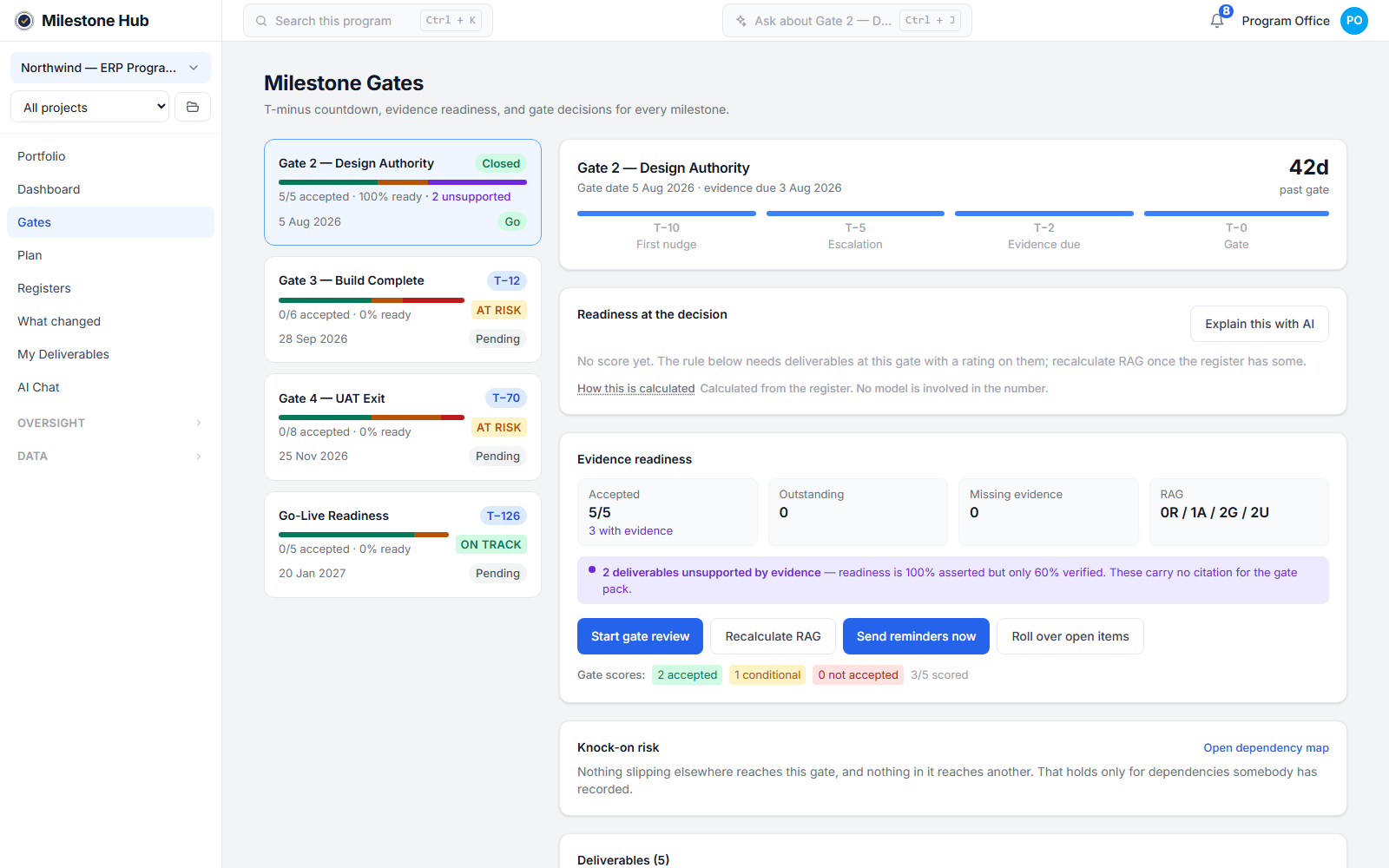
Milestone Hub · Milestone Gates — demo program
Milestone Hub gates screen: gate sequence with evidence readiness, structural rating and evidence checklist per gate
The gate screen — evidence readiness per gate, live from the record
Passed on evidenceHeld — and that's the point
The problem

Most failing programs pass most of their gates.

Industry surveys have found the same thing for years: half to three quarters of ERP programs exceed budget or timeline, or fall short of promised benefits — yet almost every one of them was formally approved at milestone after milestone. The gates didn't stop the failure, because they weren't designed to stop anything.

50–75%of ERP programs overrun budget, timeline or benefits (Panorama / Gartner surveys)
<50%of expected benefits realized by a significant share of organizations
0times most steering groups have ever seen a gate end in "no"
PATTERN 01

The date-driven gate

The milestone date arrives, so the gate happens — and passes. A gate that cannot fail is a ceremony, and everyone in the room knows it.

PATTERN 02

The self-graded gate

The party being judged assembles the evidence for the judgment. No dishonesty required: every ambiguity resolves optimistically, and the aggregate drifts green.

PATTERN 03

The slideware gate

A summary of a summary of a status report. Each compression favors reassurance; red reality arrives as an amber trend arrow with a mitigation narrative.

PATTERN 04

The chairless gate

A committee reviews; nobody decides. When the gate belongs to everyone, accountability belongs to no one — and the default is approval.

PATTERN 05

The consequence-free gate

Passed "with conditions" — and the conditions evaporate. A conditional pass without enforced conditions is an unconditional pass with better optics.

THE COMMON ROOT

Opinion, assembled

All five patterns are one failure: the decision rests on assembled opinion instead of assembled evidence. Nobody asked the mechanical question first — is the evidence complete, and what does it say?

How the Hub works

Evidence assembled by agents. Decided by a person.

1 · Define

Every gate gets an evidence contract

Each milestone's entry and exit criteria are defined against the program's deliverables register — which deliverables, in what state, verified how. Evidence becomes a checklist against the register, not a narrative.

Implex register: 190 deliverables, named owners, gates E-010 → C-005 across the full lifecycle
2 · Assemble

Agents compile the record, with citations

Ten AI agents are wired into gate preparation — status, RAID, decisions, forecasts, evidence completeness — grounded on the program's own systems of record. What reaches the decision-maker is the record, not a retelling of it.

Every agent ships governed: named owner · grounding contract · refusal rules · accuracy gate ≥90%
3 · Decide

One named Gate Chair decides

Served by the assembled evidence, the Gate Chair passes, fails, or passes with enforced conditions — conditions the next gate automatically re-examines. Committees advise. The Chair decides, and is accountable.

Judgment is never delegated to the agents. Automating the judgment abolishes governance; assembling for it strengthens it.

"The Hub assembles; the Gate Chair decides."

Gate week, with built-in AI

The milestone process, made easy.

The hardest part of an honest gate was never the decision — it was the weeks of assembly before it. With AI support built into the process, that work simply stops being human work. Evidence collects itself continuously; gate week becomes a decision, not a scramble.

Gate week without the Hub

THE SCRAMBLE
  • PMO chases every workstream for status — again — and reconciles three versions of the truth
  • Evidence hunted across SharePoint, mailboxes and someone's desktop the night before
  • Slides polished; caveats migrate to the appendix; red becomes amber with a narrative
  • Open decisions and last gate's conditions rediscovered in the meeting itself
  • The steering group decides on the deck, because the deck is all there is
≈ 2–3 analyst-weeks of assembly per gate · confidence: unknown

Gate week with the Hub

THE DECISION
  • Evidence completeness has been visible on the gate rail for weeks — no one asks "where are we?"
  • Agents assembled the record continuously from the systems where work actually happens
  • Gaps were flagged when they were cheap: weeks out, to the owner, with the citation
  • Open decisions, RAID movements and inherited conditions arrive pre-listed in the briefing pack
  • The Gate Chair walks in briefed and decides on the record — pass, hold, or pass with enforced conditions
≈ hours of human effort per gate · confidence: cited
SIGNAL, NOT NOISE

Three things need your attention. The Hub knows which three.

A program throws off thousands of data points a week; a Gate Chair needs the handful that changed the picture. The agents rank what actually needs intervention — the aging Very High defect, the decision blocking the critical path, the evidence item with no owner — and keep the rest out of the room. Leadership attention is the scarcest resource on the program; the Hub spends it where it changes the outcome.

NO STATUS THEATER

Your team delivers. The record reports.

Status is read from the systems where work actually happens — never requested from the people doing it. Nobody spends Friday writing about the week instead of finishing it, and nobody polishes the truth on the way up. What leadership sees is the record itself, cited, not a retelling shaped by the reporting chain.

GUIDED, NOT GRADED

Help your team before the slip, not after it.

Not everyone on a 200-person program has done this before. The Hub's knowledge agents answer "what does this deliverable need, in what state, and why" straight from the playbooks — so a less experienced owner gets it right the first time, instead of finding out at the gate. Missed deliverables stop cascading into delays because they stop being missed.

CATCH IT EARLY

Find the month-two miss in month two.

The classic program disaster: month six reveals that a month-two deliverable was never really finished — and five months of cross-workstream work is built on it. The Hub tracks those dependencies automatically against the register, so the incomplete item is flagged the week it slips, to its owner, while fixing it is still cheap. Nothing waits until it's expensive to be discovered.

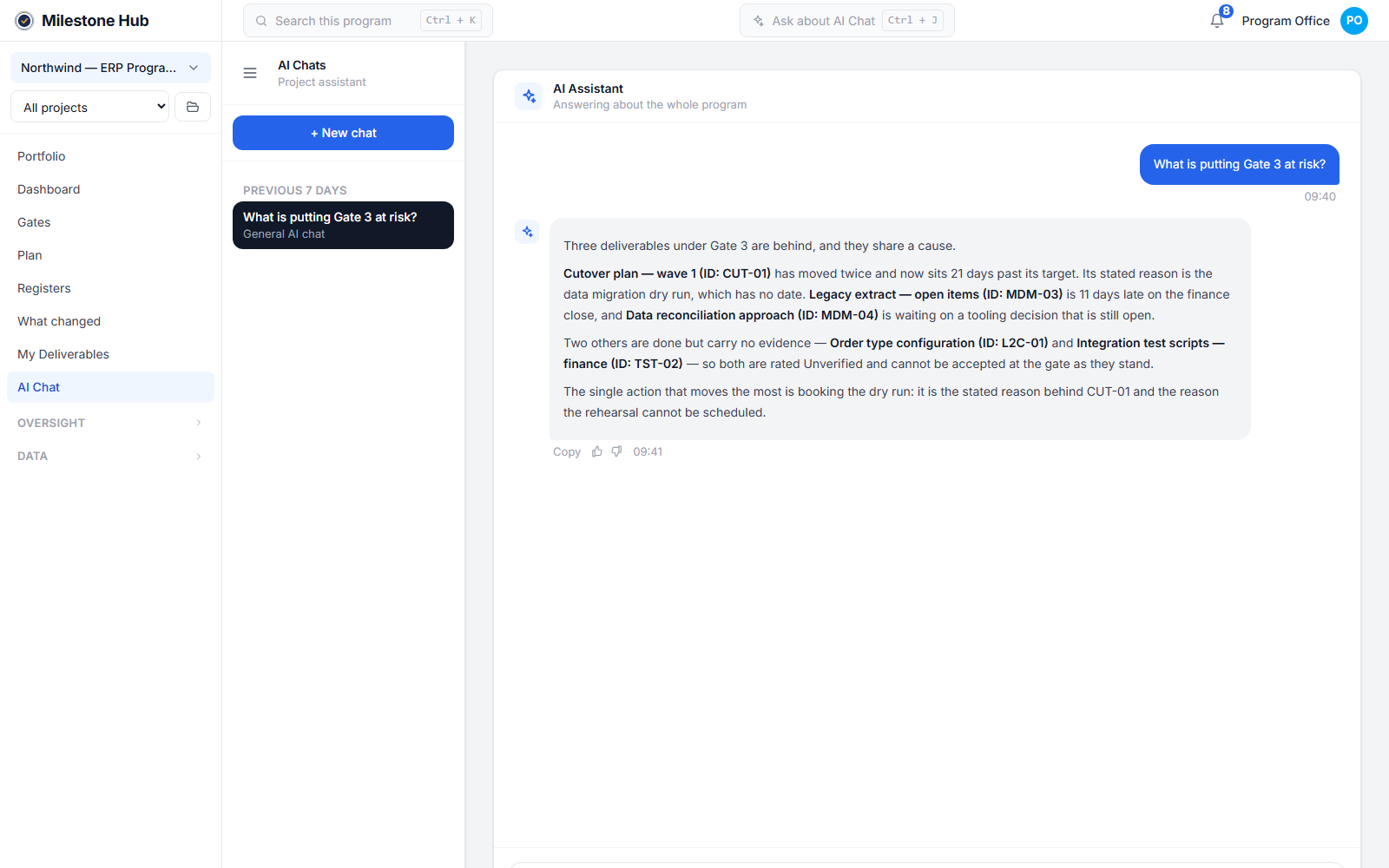
Milestone Hub AI assistant answering program questions in chat
Built-in AI support — ask the program anything: status, evidence, decisions, playbooks. Answers come from the record, cited.

Your next gate is closer than you think. Walk in with the evidence.

Get your gate assessed — 3 weeks
Inside the Hub

What's actually in it.

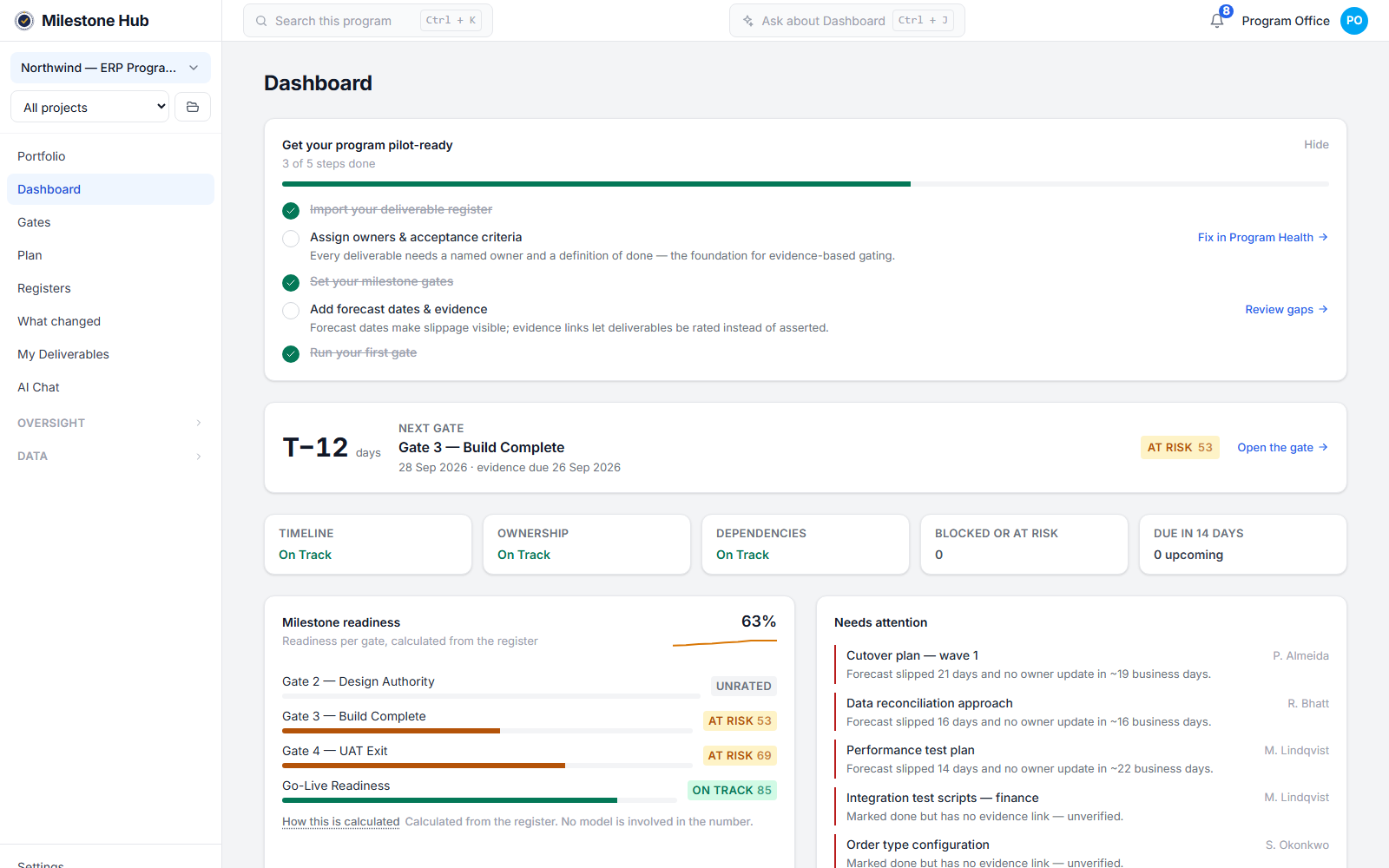
The Hub is not a dashboard bolted onto a methodology. It is the working surface of the Implex milestone model — six capabilities that together turn the gate protocol into a daily operating rhythm.

Milestone Hub dashboard with gate readiness, attention items and program summary
01 · THE DASHBOARD

The whole program, one screen

Gate readiness, what needs attention, and where the program actually stands — assembled from the record, not from status meetings. This is the screen the steering group should be looking at.

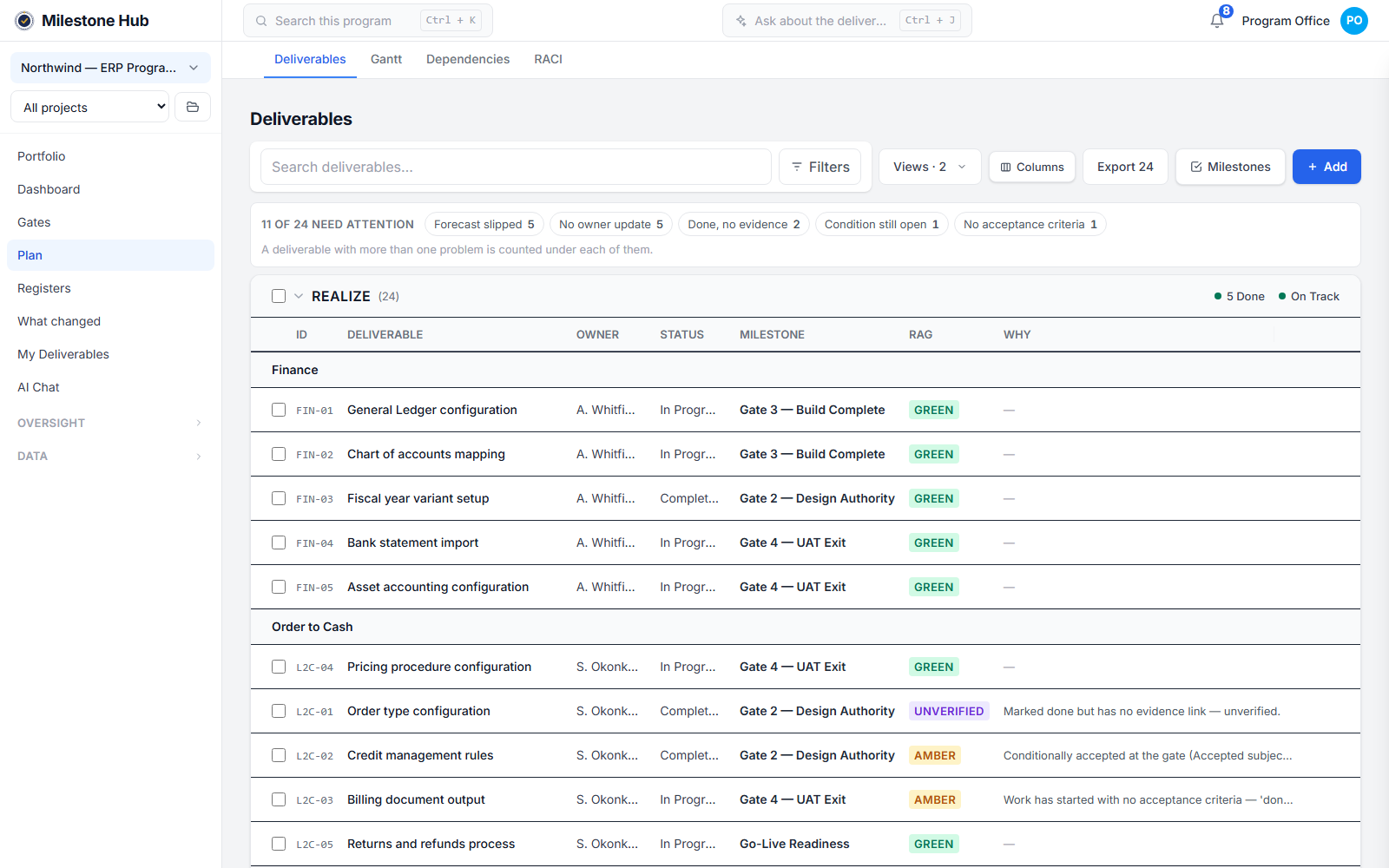
Milestone Hub planning screen: deliverables by phase with owner, status and gate
02 · PLANNING & THE REGISTER

Every deliverable, owned and gated

The deliverables register as a working plan: every item with its owner, state and the gate it serves. Slippage is flagged against the countdown while correction is still cheap — not discovered at the gate.

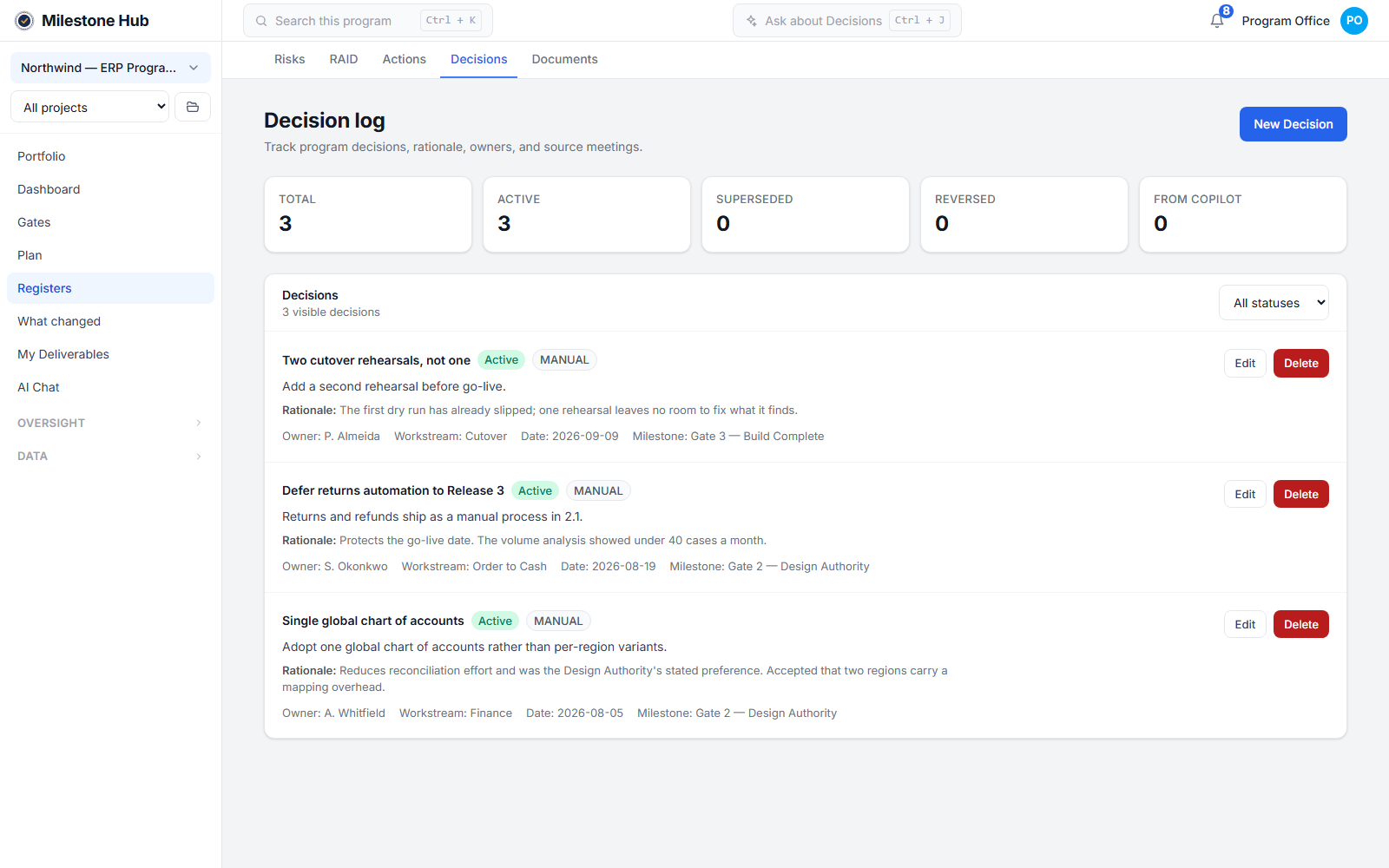
Milestone Hub decision log with open decisions, owners and gate references
03 · DECISION & CONDITIONS LEDGER

Nothing evaporates

Open decisions with owners, age and what they block; every condition attached to a passed gate, carried forward and re-examined at the next one automatically. A conditional pass finally means something.

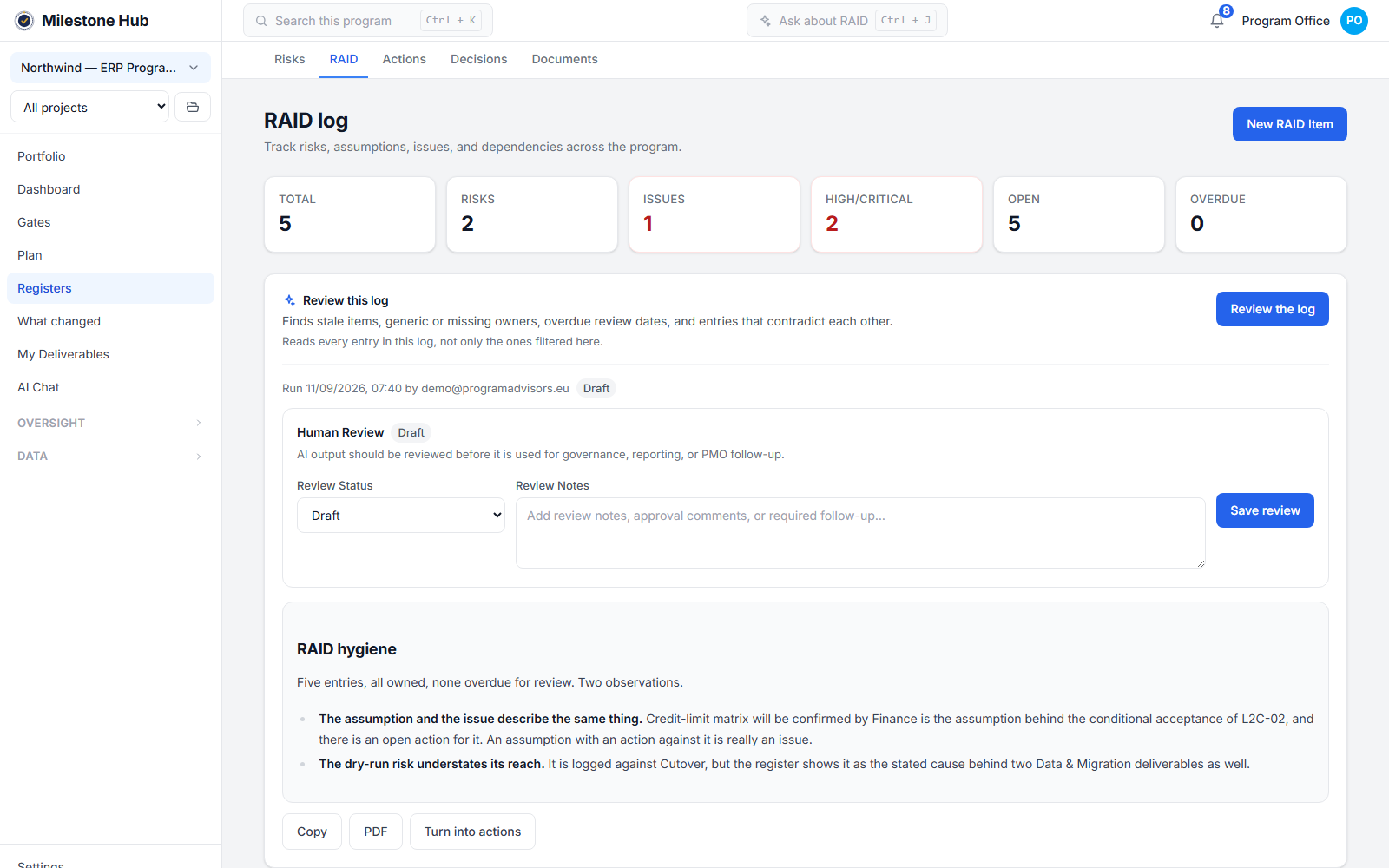
Milestone Hub RAID log: risks, actions, issues and dependencies with owners and status
04 · LIVE RAID PICTURE

Risks from the record

Risks, issues and dependencies extracted from where they actually surface — minutes, tickets, test results — not just from what someone remembered to log. Movement since the last gate is part of every briefing.

Milestone Hub weekly PMO status report generated from the record
05 · REPORTS & BRIEFING PACKS

The Chair walks in ready

Weekly status and the gate briefing generated from the record with citations throughout: evidence completeness, exceptions ranked by consequence, inherited conditions, open decisions, forecast. Read in twenty minutes.

Milestone Hub program health screen with delivery status by workstream
06 · PROGRAM HEALTH

Trajectory, not snapshots

Delivery status by workstream with the trend behind it — where the program is heading, not just where it stood on Friday. Behind it all, every agent is audited weekly against its sources, with ≥90% retrieval accuracy as the standing bar.

Reads your systems of record SAP Cloud ALM SharePoint & Teams Jira / Azure DevOps The deliverables register Minutes & decision logs
The agents

Ten agents, wired into every gate.

Program-intelligence and knowledge agents from the Implex AI Fabric prepare each milestone continuously — not in the panicked fortnight before the steering meeting.

Program Pulse · status & forecasting Status Drafter · consolidated reporting Executive Briefing · decision packs Health Predictor · trajectory warnings RAID Extractor · risks & issues from the record Decision Log Keeper · open decisions & latency Evidence Auditor · completeness vs. exit criteria Document Finder · the live version, cited Metadata Structurer · a register agents can trust Template Guardian · deviation & reuse checks

Each agent is governed like any other program resource: a named owner, a documented grounding contract with ranked sources, explicit refusal rules, and an accuracy gate it must pass before deployment. First agent answering on real program data in ten weeks.

The Monday morning test

Test your gates in five questions.

No tooling required — answer for your own program's next milestone.

Q1Has any gate on this program ever ended in "no"?

Q2Is the evidence for the gate assembled by someone other than the party being judged by it?

Q3Could you list, today, the specific deliverables and states the gate requires?

Q4Does one named person decide the gate — and do they know they're that person?

Q5Were the conditions from your last passed gate re-examined at the next one?

Answer all five — two or more "no" answers is the normal score, and the reason gate governance is where most programs have their cheapest improvement available.
Built on experience

Every rule in the Hub was learned on a real program.

Nothing here was designed in a lab. Every gate protocol, evidence contract and guardrail in the Hub comes from first-hand leadership of global SAP template-and-rollout transformations — programs with hundreds of people across workstreams, countries and time zones, where a gate passed on a polished deck costs millions six months later. What's new is the engine underneath: recent advances in agentic AI now carry the assembly — continuous evidence collection, real-time risk visibility and fully data-driven reporting — at a cost no PMO could ever staff for.

100+go-lives delivered
120 yrsof combined program management

That's also why the Hub sits on your side of the table. Your implementation partner delivers; the Hub watches the evidence of that delivery. The party assessing the work can never be the party doing it — a seat the big firms structurally cannot take, and the one your steering group most needs filled.

Getting started

Start with one gate. Yours. Three weeks from now, you'll know.

The Hub deploys into a running program in weeks and works alongside the implementation partner you already have. It judges evidence, not people — clean delivery passes gates faster. And it sits on your side of the table: the party assessing delivery cannot be the party delivering.

STEP 1

Gate Readiness Assessment

3–4 weeks · fixed scope

One upcoming gate, audited against the evidence model: your register mapped, the evidence gaps named, your Gate Chair briefed. Your next go/no-go, decided on what is actually there.

The starting point
STEP 2

Hub Deployment

10–14 weeks

The gate model tailored to your program, the tracker installed on your register, the agents deployed and grounded on your systems of record, your TMO enabled — and your next two gates run assisted.

First agent live in 10 weeks
STEP 3

Hub Operate

Ongoing

Program Advisors runs the Hub between your gates: agent operation, weekly grounding audits, gate preparation, and continuous evidence — a camera left running, not a quarterly photograph.

Continuous assurance
The research

Built on an argument, not a slogan.

The Hub implements the Implex methodology's milestone model — a published deliverables register, a defined gate protocol, and an AI Fabric whose every agent ships with a specification, a grounding map and a human approval point.

Our insight-paper series sets out the full case: why gates fail, why program status drifts green, and what governance-grade AI in program management actually requires.

Insight paper 1 of 6

Why Gates Fail

The five failure patterns of milestone governance, the four design rules of the evidence-based gate, and the Monday morning test — the case for deciding programs on evidence.

Request the paper